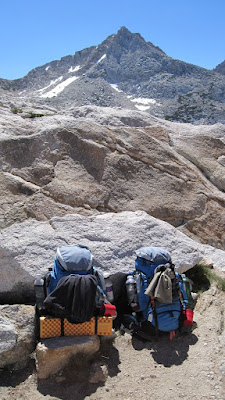
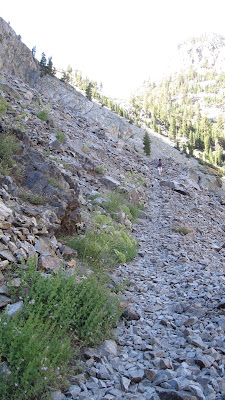
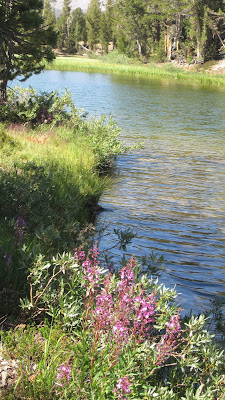
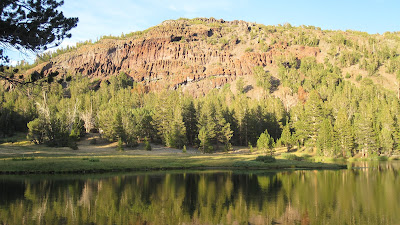
Photos from our trips in 2012. From left to right: Summit Creek in the Emigrant Wilderness, Bumpass Hell in Lassen Volcanic National Park, and resting by Waugh Lake in the Ansel Adams Wilderness.
|
posted Aug 29, 2012 9:15 PM by Paul Wagner
School is now in session, parents are back to work, and the mosquitoes have given up entirely.
It's the perfect time to go hiking in the High Sierra. The crowds are gone, the fish are biting, and the weather is usually just about perfect.
True, we've had perfectly wonderful trips at other times of the year, and every trip is great. But the next month or so is our favorite time to go hiking.
We can hardly wait.
|
posted Aug 24, 2012 8:22 AM by Paul Wagner
It isn't easy to send us comments on this blog, since Googlesites makes it all a bit silly. In the end, we have to suggest that you simply write to us at our contact info, and then we will post your notes on our comments page. Luckily, that has stopped people from writing to us. And the most recent note, from someone who had a simply great trip (and a great time getting ready for it) is just one of the wonderful notes we've received. If you haven't read the comments on our site, you can check them out here: comments And if you'd like to add your comments, you can do that, too. Just scroll to the bottom of the navigation bar at right, and click on the "contact us" button. We promise to answer! |
posted Aug 23, 2012 9:27 AM by Paul Wagner
If you've read these pages at all, you know that we're big fans of keeping both weight and costs low. Sure, we have a couple of expensive items that are really light, but we also have a ton of stuff that didn't cost much, and is as light as anything you can buy. And some of that stuff we made ourselves. On our recent trip to the Emigrant Wilderness, we were particularly pleased with the pot cozy that P made out of some old closed-cell foam. It's pretty darn simple--just a cylinder and a lid, to match the pot--but it kept our freeze-dried dinners piping hot for the full fifteen minutes that we left them to re-hydrate. It worked perfectly. And it cost us nothing. And it weighs almost nothing. That's it upper right in the photo below, with it's silver foil outer covering that P cut out of a insulated package he got in the mail. 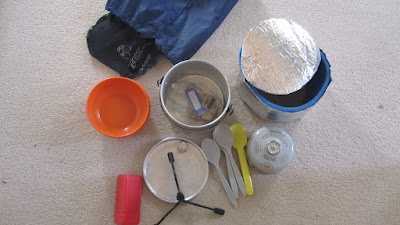 Sadly, M forgot her closed-cell foam seating pad that she always tucks into the straps on the back of her pack. We use these as seats on the trail, as they are a lot softer than a rock. They cost nothing, and they weigh nothing. M also uses them as a windbreak for the stove on breezy evenings. When we are pumping water, they give us just enough cushion to keep our bones from aching. This trip we had to share, as M left hers at home! You can see one of these below, curled up a bit in front of M. She's sitting on the other one. 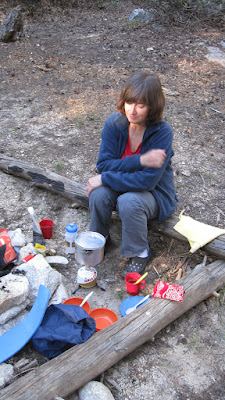 We also tied on a quick net of elastic cord on the outside of our packs, so that we can put a fleece jacket, our crocs, or one of these pads on the outside of the pack. We paid less than $2 for the cord, and it makes a huge difference on the trail. In the photo below left you can see how these work, with crocs, pant legs, foam seats, and fleece all held in place by this convenient cord. And you can add to that our cutting board, a 4x6 inch square cut from a larger flexible plastic cutting board we bought at a local gourmet deli. Net cost/ Under $5, and a perfect lightweight solution to either cutting your leg with the knife, or cutting salami on a rock...and leaving the edge of your knife as dull as conversation with the rock itself. Cheap. Light. Easy. |
posted Aug 22, 2012 8:39 AM by Paul Wagner
Last year we learned about a very sophisticated group of thieves who were subscribing to all the latest environmental newsletters to see who had installed new solar energy systems. It was basic market research, because within weeks the thieves would then visit the new installation and cart the whole thing away. Not nice, and happily that group was arrested and put out of business. But that's the reason that we never announce when and where we are taking our next backpacking trip. We're happy to tell you all about it once we have returned, but the Internet is just a bit too public a place for us to announce that our house is going to be uninhabited for certain dates. We've had people ask us the question, and we always demur. And yeah, we have neighbors who check on things. but even so. These days you can't be too careful. We encourage you to do the same. |
posted Aug 21, 2012 8:20 AM by Paul Wagner
Have you ever gone backpacking without the required permit? Would you? We got to thinking about this after a recent trip to the Ansel Adams Wilderness. We had arranged for our permit to be left for after-hours pickup at the Mono Lake station. But when we got there, the permit box was empty. We looked and looked. Poor Mother Hubbard! It wasn't a big deal. We were camping at Silver Lake, about fifteen minutes away, and so we simply got up the next morning and drove back to the ranger station and picked up our permit from a live and slightly apologetic ranger. The phones had been down the night before, and they never got the word from the main office. End result? We hit the trail about an hour later than planned. As we said, no big deal. 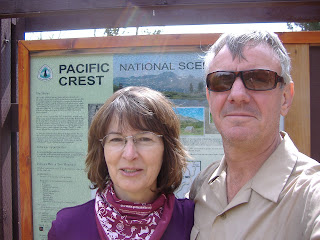 But what if the situation had been different? We once called the El Dorado National Forest to make sure that we could pick up a permit at the trailhead for a trip we were going to make out of Carson Pass. We were assured that it was not a problem--the Carson Pass station was open 9-5 or so. We left home early the next morning, and drove to Carson Pass...only to find that the USFS station up there was not open during the week (This was in the fall. Summer hours may well be different.) The station was boarded up, there was no phone (or cell phone coverage) and not even another car in the parking lot. Our only option was to drive another hour or more back down to Placerville, pick up a permit, and then drive back up to Carson Pass and start hiking. We'd already been in the car for more than three hours, and it was now 11:30 in the morning. If we drove to Placerville, we would not get on the trail until 2 p.m. or so. We read the warning signs carefully, all of which stressed that we could not make a campfire (or cook on a stove) without a permit. But we did have our CDF campfire permit. We get one of those every year.  So we decided to hit the trail. We spent three lovely days in the not yet established Meiss Meadow Wilderness Area, and hiked back out on Saturday afternoon. We'd seen very few people, and by the time we got to the car, we'd forgotten that we didn't have a permit.  No, we didn't get stopped at the trailhead and arrested. In fact, we weren't noticed at all. Clearly, this is not something we would consider in Yosemite National Park or other high traffic and highly regulated areas. And some of the other areas allow you to simply self-registed for a permit at the trailhead. We did that at Leavitt Meadows. But now you know our secret confession. We once backpacked without a permit. We expect to appear on the next season of America's Most Wanted. Photos are of the fugitives during their escapade. |
posted Aug 20, 2012 4:09 PM by Paul Wagner
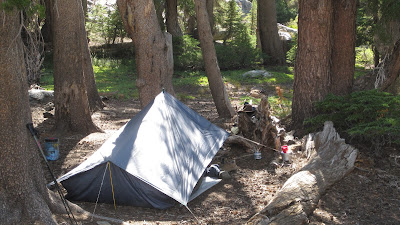
The reason you haven't heard from us for a few days is that we were doing what we love--backpacking in the Sierra. This time it was around Emigrant Wilderness, to a series of lakes for which there is no trail, only sloping slabs of granite and a topo map to guide us. We started at Kennedy Meadows and followed the horses and manure for five miles up to the junction with the trail to Lower Relief Valley. It had rained torrents the night before (we met one group who weathered five hours of thunder, lightning, and pouring rain near Emigrant Lake) and so our normally dry Sierra felt like a sauna. Steam was rising off the rocks, and we were sweating like...well, we were sweating. That's the gorge below left...and you can see the steam rising.  But once we got above Relief Reservoir, things got a lot better. The trail goes through a very steep climb here, and after lunch we stopped at Summit Creek to enjoy the water, the view...and what the heck, let's camp here. That afternoon P took a recon hike up the granite just to make sure this route was possible...and came back down full of confidence. That's the view from near our campsite, below right. The next morning we were up early and hiking straight up the smooth granite. What a wonderful way to explore the Sierra! The views opened up, and there were so many fabulous trees struggling in the granite that we kept stopping to take photos of them. You can see all of our photos on our Picasa page for the trip: In about an hour we were up at the top of the pass, and then pulled out our map and compass to make sure we were headed in the right direction. We contoured around the granite bowl, and ended up right where we wanted to be, at the northern corner of Ridge Lake. From there we hiked around to explore the three other lakes, fish a bit, and spend the day far from the madding crowds below. Wonderful. The sky was full of fluffy clouds, and we just wandered from one great spot to the next. Iceland Lake is below: The last day was Friday, and we started early to beat the heat. Most of the hike back down to Kennedy Meadows was in shadow...but we also ran into seven (yep, seven!) groups of horses, from three to fourteen people in each. Add in a few groups of hikers, and it sure felt different from Iceland Lake. This is not a trip for those who want a nice hike along a well-marked trail. In fact, the lakes in question are well off the trail, and take quite a bit of navigation. But they are lovely lakes, and we promise you that you won't see many people up in this area. And the scenery and fishing is pretty darn amazing. (Note--we did not see a single fish at Iceland lake--only pollywogs. But Ridge Lake and its companion were full of fish, as was Summit Creek.) |
posted Aug 14, 2012 5:40 AM by Paul Wagner
Over the past three months, P has been struggling with a bad right knee. He first hurt it while cycling in late April, and felt a twinge behind his kneecap. After that, there was pain, swelling, strange locking up of the knee, and a general sense that all was not right in Kneeland. And it didn't go away.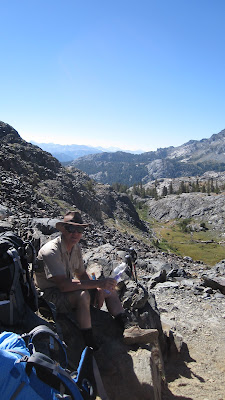
He gave up cycling for two months and tried to give the knee a period of rest and relaxation. But as backpacking season was coming and going, and the knee wasn't getting any better, he decided to consult his physician.
X-rays and a consultation later, and the news came back that he had arthritis in the knee. Not bad arthritis, but enough to make an issue of things. This was not great news. And the next step was to consult an orthopedist, which he did in mid-July. A long consultation confirmed that his ACL and MCL were fine, but that there might be something else wrong in there. And the arthritis didn't look that serious. Time for an MRI. In the meantime, he was instructed to let pain and discomfort be his guide. He could cycle, hike or leap tall buidling with a single bound, as long as it didn't seem to make his knee worse. And so we took a backpacking trip. There he is at left, between Garnet and Thousand Island Lake, at 10,000 feet. Note that his knee is there, too. But we also took precautions. For the first time, P carried (and later used) hiking poles. We took a generous supply of Advil, and chose a route that would allow us to bail out early if things got gruesome. We packed light, as we usually do, and we agreed to take things easy. And we took a small knee brace, too. The first day up the steep ( we took it slow and sure) Rush Creek trail was fine. P felt great, the knee didn't hurt more than usual, and all systems were a cautious go. The second day .was even better. By the time we got to camp that afternoon, P was feeling the best he'd felt in a couple of months. He went fishing at Altha Lake and had a lovely time. But the next morning, within a half-mile of leaving camp, he noticed a new and distinctive pain in the knee. He immediately took some Advil, pulled out the poles, and spend most of the day worrying. He was worrying that our route this day was taking us farther from the trailhead, and this was the one day that offered a chance to leave early. He stuck it out, the knee didn't get worse, and by the end of the third day he was hopeful that the worse was over. Day four was a series of climbs and descents, including a half-mile bushwhack along the San Joaquin River, and by this time he was using the poles and taking an Advil every six hours, and using the knee brace--including dipping it in icy where he could to cool the knee while he hiked. But it worked. The knee held up fine, and actually felt better than the day before. In the photo at left, you can see him in full preventive regalia, posing on the Rush Creek Trail. The last day was a descent of 2500 feet steeply down the Clark Lake/Rush Creek trail. This trail is no fun, but with his assortment of protections and medications, P's knee held up to the very end. In fact, by the end of the trail it felt no worse than his other knee...which was also feeling the long descent. That's the trail at right (M is that tiny dot halfway up the trail), and it simply goes straight down about 600 feet per mile for miles. But we did it. Mission Accomplished. And the even better news? A few days after returning, his orthopedist gave him a cortisone injection in the knee...and not only is the pain gone, but the swelling is greatly reduced. We're hoping that will give the knee a chance to do a little recovery on its own, and we'll be back on the trail in no time. Wouldn't THAT be nice? |
posted Aug 13, 2012 12:44 PM by Paul Wagner
Quite a few people have asked us about the camera we use for our photos. Many of them seem to think that we have an expensive and sophisticated system. We don't. We have an old Canon Powershot 780 that cost us about $225 three or four years ago. We have carried it for hundreds of miles on the trail and literally hundreds of thousands of miles on airplanes. In that time period, we've probably taken 5,000 photos with it. And we are pretty darn happy with it. We bought it for two major reasons: 1. It has a viewfinder. P doesn't like using an LCD screen in bright sunlight--particularly because he wears polarized sunglasses on the trail--and that means you just can't see the screen in the daytime. 2. It's small, smaller than his Blackberry, and weighs only about five ounces. That makes it easy to take wherever we are going. We would post a photo...but we'll have to find a mirror first...grin. Instead, we'll just post a couple of photos from our last trip. The one upper left is a shot of moonlight on the water at Waugh Lake. And below right is M enjoying the view from one of our campsites. It reminds us a bit of a Maxfield Parish painting. Over the years, he's learned how to adjust exposures, use the zoom to frame the photo, and adapt to the viewfinder, which always shows a bit less of the scene than you'll see on the final photo. So the next time you a photo you like on this website, don't be misled. It wasn't taken by someone who knows a lot about photography. And it wasn't taken with a complicated SLR camera with lots of lenses or attachments. It was taken by someone who got up into the Sierra so far that anyone could take a picture and have it look good. And if you want to see more photos, you can always go to our Picasa pages, where there are more photos than you'll ever want to see. |
posted Aug 12, 2012 2:42 PM by Paul Wagner
You may remember from our visit to the Clark Lakes on our last trip that we weren't impressed with the grassy shoreline and bug potential along Lower Clark Lake below Agnew Pass. One half of the lake was full of grass, and the rest of the shoreline was often grassy as well. We even decided to look elsewhere for a campsite at first. Happily, Lower Clark lake turned out to be a great place to camp. And as the day wound down, the wildlife came out to play. We first heard the yip of a coyote, our first of the trip. And as M sat by the lake she enjoyed the family of ducks that was paddled on the far shore--a mother and five almost grown up ducklings. The mom chased them about a bit, then finally let them explore the far shore as we watched from our campsite above the lake. Two deer came quietly out of the forest and snacked their way down to the lake, nibbling on the grass as they traveled. The lone hiker that we could see was oblivious to their presence as they ate their fill and then slowly slipped back into the forest. Overhead, an osprey soared over the lake, looking for a fish dinner. After a few minutes, he flew higher up the slope, hoping to find something more appetizing at the Upper Clark Lake. As we watched him, we took notice of the dragonflies that were dashing about, gobbling up the tiny midges that were hatching over our side of the lake. A few bats came out, flying overhead, competing with the dragonflies for bugs. And then we noticed a smaller family of ducks--a mother and two duckings--making their way from the grass on our side of the lake to visit their colleagues on the far side. They paddled across quietly, then began jabbering and diving to the bottom with the others. The sun hit the horizon and shadows lengthened across the lake. The five ducklings in the first family were now swimming down to the end of the lake, and as we watched they started to come back along the shore on our side. Although we sat motionless, they knew we were there. As they came within about fifteen feet of where we were seated, they changed course to go a bit further out into the lake, giving us just enough of a wider berth. Once past us they paddled along and into the grass to our right, and we could hear them making noises for some time afterwards, settling in for the night. The sun went down, and the full moon rose over the lake. For a campsite we had tried to avoid, it was a perfect way to end the day. |
posted Aug 10, 2012 9:01 AM by Paul Wagner
Did you lose a pair of reading glasses? When we go into the backcountry, we often go out of our way to find more remote and private campsites. Part of the joy of backpacking is the sense of solitude and isolation that we find. And that means that we often find ourselves camping boldy where no man has camped before. Well, not really. But you get the idea. Show us the usual sites, and we'll often look for something a bit farther afield. On this last trip, we were off the John Muir Trail, exploring trails and routes that didn't get so much traffic. And when we stopped for the night, we often spent 45 minutes or more finding a place to camp that would be away from the madding crowd--or at least other hikers. In one case, we considered one campsite, then decided to move on. But before we moved on M noticed a pair of glasses on a log. She actually ought they were mine, and handed them to me. But I had mine right where I wanted them---on my face. This pair had been on the log for a while, judging from the water spots and corrosion on the frames, so we tossed them in our pack and added them to the junk we've found on the trail. And then a few days later, we were even farther off the grid, and M wandered off in the woods to do what bears do. Of course, she likes to get far away even from our isolated campsite for that particular activity. When she returned, she was laughing, and holding up a pair of glasses. A different pair. So we have two pairs of reading glasses right now. They are both about 1.5 magnification, and we'll donate them to a local charity shop. But it does make you wonder how many other pairs are out there...and how many people are having trouble reading their topo maps. |
|