


Diplomat: N. Korea Tests Are Intimidation Tactic
 Enlarge
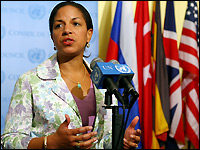
U.S. Ambassador to the United Nations Susan Rice speaks to the media Monday in New York City following an emergency session of the United Nations Security Council concerning an underground nuclear test by North Korea. Getty Images
NPR.org, May 26, 2009 · U.S. Ambassador Susan Rice said Tuesday that North Korea is "trying to test whether they can intimidate the international community" with an underground nuclear test and launching of short-range missiles.
"But we are united. North Korea is isolated, and pressure on North Korea will increase," Rice, who represents U.S. interests at the United Nations, said a day after President Obama assailed Pyongyang, accusing it of engaging in "reckless" actions that have endangered Northeast Asia and the Korean peninsula.
Speaking a day after the U.N. Security Council condemned the tests as a "clear violation" of a 2006 resolution banning the regime from developing a nuclear program, Rice said she believes that Pyongyang "is surprisingly in tune to international reaction" and said she hoped that it can result in North Korea backing off from its nuclear intentions.
U.S. officials have been reluctant in this latest episode to discuss specifically what options are available for reining in Pyongyang, although neither the Obama administration nor the Bush and Clinton administrations before it ever publicly took the military response option off the table.
Rice acknowledged that U.N. Resolution 1718, passed by the Security Council in 2006, lacked strong sanction enforcement provisions and said that more recently, "we actually put teeth" in a developing resolution to supplant that one.
Asked why Pyongyang could be expected to honor any such resolution given its indifference in the past, she said, "North Korea is surprisingly in tune to international reaction, and they are trying to test whether they can intimidate the international community."
Rice also suggested that China is growing increasingly irritated with Pyongyang and said that likely presents the United States with a stronger diplomatic option, and more international consensus, this time around.
"China has interest in North Korea," she said. "They want to see North Korea stable and without nuclear weapons. China has played a constructive role. We and our partners need to agree on a package (of sanctions) that will cause North Korea to change its course."
Rice also credited Russia with helping increase international pressure on Pyongyang.
The two missiles — one ground-to-air, the other ground-to-ship — with a range of about 80 miles were test-fired from an east coast launch pad, South Korea's Yonhap news agency reported, citing an unnamed government official.
South Korean spy chief Won Sei-hoon had informed lawmakers earlier Tuesday that a missile test was likely, according to the office of Park Young-sun, a legislator who attended the closed-door briefing.
Yonhap reported that North Korea was preparing to launch a third missile from a west coast site, again citing an unnamed official.
North Korea appeared to be displaying its might a day after conducting an underground atomic test in the northeast that the U.N. Security Council condemned as a "clear violation" of the 2006 resolution.
France called for new sanctions, while the U.S. and Japan pushed for strong action against North Korea for testing a bomb that Russian officials said was comparable in power to those that obliterated Hiroshima and Nagasaki during World War II.
South Korea, meanwhile, announced it would join a maritime web of more than 90 nations that intercept ships suspected of spreading weapons of mass destruction — a move North Korea warned would constitute an act of war.
North Korea had threatened in recent weeks to carry out a nuclear test and fire long-range missiles unless the Security Council apologized for condemning Pyongyang's April 5 launch of a rocket the U.S., Japan and other nations called a test of its long-range missile technology. The North has said it put a satellite into orbit as part of its peaceful space development program.
Monday morning's nuclear test appeared to catch the world by surprise, but Won told lawmakers that Beijing and Washington knew Pyongyang was planning a test some 20-25 minutes before it was carried out, said Choi Kyu-ha, an aide to lawmaker Park.
Won said Pyongyang warned it would test the bomb unless the head of the Security Council offered an immediate apology. Russia said the test went off at 9:54 a.m. local time Monday. Won confirmed that two short-range missile tests from an east coast launch pad followed.
Yonhap reported that three missile tests were carried out Monday, and two more Tuesday.
North Korea's neighbors and their allies scrambled to galvanize support for strong, united response to Pyongyang's nuclear belligerence.
Obama and South Korea's Lee Myung-bak "agreed that the test was a reckless violation of international law that compels action in response," the White House said in a statement after the leaders spoke by telephone. They also vowed to "seek and support a strong United Nations Security Council resolution with concrete measures to curtail North Korea's nuclear and missile activities."
Obama also spoke with Japanese Prime Minister Taro Aso, the White House said, with the leaders agreeing to step up coordination with South Korea, China and Russia.
Obama reiterated the U.S. commitment to defend both South Korean and Japan, U.S. and South Korean officials said.
North Korea responded by accusing the U.S. of hostility, and said Tuesday that its army and people were ready to defeat any American invasion.
"The current U.S. administration is following in the footsteps of the previous Bush administration's reckless policy of militarily stifling North Korea," the North's main Rodong Sinmun newspaper said in commentary carried by the country's official Korean Central News Agency.
In Japan, which suffered the devastation of two atomic bombs in 1945, the lower house of parliament quickly passed a unanimous resolution condemning the test and demanding that North Korea give up its nuclear program, a house spokeswoman said.
"This reckless act, along with the previous missile launch, threatened peace and stability in the region, including Japan," the resolution said.
"North Korea's repeated nuclear tests posed a grave challenge to international nuclear nonproliferation," it said. "Japan, the only nation to suffer atomic attacks, cannot tolerate this." Japan is considering tightening sanctions against North Korea, the statement said.
Russia, which called the test a "serious blow" to the effort to stop the spread of nuclear weapons, suspended a Russia-North Korean intergovernmental trade and economic commission, apparently in response to the nuclear test. The slap on the wrist was a telling indication that Moscow, once a key backer of North Korea, was unhappy with Pyongyang.
Seoul reacted to the nuclear test by joining the U.S.-led Proliferation Security Initiative, joining 94 nations seeking to intercept ships suspected of carrying nuclear, chemical and biological weapons, materials to make them, or missiles to deliver them.
North Korea for years has warned the South against joining the U.S.-led blockade. The Rodong Sinmun last week said South Korea's participation would be "nothing but a gambit to conceal their belligerence and justify a new northward invasion scheme."
Joining the PSI would end in Seoul's "self-destruction" it said.
In Beijing, the defense chiefs of South Korea and China were holding a security meeting Tuesday, South Korean officials said.
South Korean Defense Minister Lee Sang-hee and China's Gen. Liang Guanglie were expected to discuss ways to respond to the nuclear test, Cho Baek-sang, international policy director at the Ministry of National Defense in Seoul, was quoted as saying by Yonhap news agency.
China said Monday it "resolutely opposed" North Korea's test and called on Pyongyang to return to talks on ending its atomic programs.
Related NPR Stories
-
May 26, 2009North Korea Defies Warning, Conducts Test
-
May 26, 2009North Korea Nuclear Test Harms U.S. Relations


Comments
Please note that all comments must adhere to the NPR.org discussion rules and terms of use. See also the Community FAQ.
You must be logged in to leave a comment. Login | Register
More information is required for you to participate in the NPR online community. Add this information
NPR reserves the right to read on the air and/or publish on its Web site or in any medium now known or unknown the e-mails and letters that we receive. We may edit them for clarity or brevity and identify authors by name and location. For additional information, please consult our Terms of Use.