

Matisse vs. PicassoYou're either one or the other. Take this test.
Updated Saturday, March 6, 1999, at 3:30 AM ET"Matisse and Picasso: A Gentle Rivalry"
Kimbell Art Museum, Fort Worth, Texas
Jan. 31-May 2, 1999
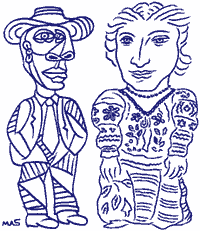 The relationship between the artists Henri Matisse and Pablo Picasso is the subject of a new exhibition at the Kimbell Art Museum in Fort Worth, Texas, called "Matisse and Picasso: A Gentle Rivalry." The theme of this show, and of the book that accompanies it by the Harvard art historian Yve-Alain Bois, is that the two masters of modern painting were playing a kind of chess game all their lives. Picasso, the younger artist, was constantly trying to get Matisse's attention by showing off, stealing from his work, and rudely parodying him. Matisse, envious of Picasso's success, tried to ignore him until the 1930s when he needed Picasso's influence to bring himself out of an artistic funk. After that they traded paintings, visits, and little notes. But they were too competitive to really be friends.
 PRINT
PRINT DISCUSS
 E-MAIL
 RSS
RSS RECOMMEND...
 Facebook
 Digg
Digg Reddit
 StumbleUpon
I don't think Bois takes this implication of this creative tension quite far enough. The Matisse-Picasso rivalry is more than just the great artistic competition of the 20th century. It's a scheme for dividing all art into two parts. Side by side, a Matisse and a Picasso can look amazingly similar. Yet at a deeper level, they are fundamentally, radically incompatible. Although it's possible to admire both artists, something impels you to choose sides. At the end of the day, everyone is either a Matisse person or a Picasso person.
M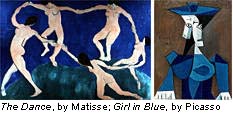 atisse is a cool, calm, Northern European artist. Picasso is a hot, temperamental Spaniard. Matisse famously said that a painting should be like a comfortable armchair. His paintings are harmonious, luxurious, and soothing. Picasso can virtually copy a Matisse tableau without producing anything like the same effect. In his rendition, the same fruit on a pedestal contains an element of dissonance, disturbance, and even violence. Where Matisse is sensuous, Picasso is sexual. Matisse loves fabric. Picasso loves flesh.
The division seems like a version of the one drawn by Friedrich Nietzsche in The Birth of Tragedy between Apollonian and Dionysian art. The Apollonian comes from the Greek god Apollo, the god of light, who was associated with rationality and its subspecialties law, medicine, and philosophy. The Dionysian comes from Dionysius, the god of wine and fertility, who was worshipped with drunken orgies in the woods at which nonparticipants were ripped to pieces. The Apollonian spirit is one of measure, reason, and control; the Dionysian is one of abandon, irrationality, and ecstatic release. The clash between the two principles was what produced Greek tragedy, according to Nietzsche. That Matisse is essentially an Apollonian artist and Picasso a Dionysian is evident even from the backhanded compliments they paid each other. Matisse called Picasso "capricious and unpredictable." Picasso described Matisse's paintings as "beautiful and elegant."
 In dividing all art into two categories, Nietzsche rendered the service of coming up with one of the great intellectual parlor games of all time. Critics love to devise variations for their fields. Richard Martin, the director of the Costume Institute at the Metropolitan Museum of Art in New York City, divides the world into Giorgio Armani vs. Gianni Versace. Armani, with his serene, muted tones and clean lines, is the Apollonian designer. The late Versace, with his Miami colors, outrageous impracticality, and explicit sexuality, is the Dionysian. And it's true: The models in Armani ads look like Greek statues. In Versace ads, they look like drugged bacchants. The Apollonian spirit is about good taste, elegance, and beauty. The Dionysian mixes bad taste with good taste, pain with pleasure.
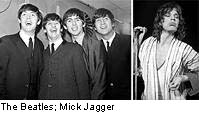
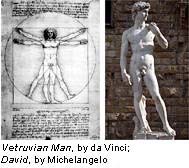 You can apply Nietzsche's dichotomy to just about any set of contemporaries or creative rivals. With artists, you might start with Leonardo vs. Michelangelo. Leonardo, the scientific rationalist and inventor, is an Apollonian (his work is owned by, among others, the archrationalist Bill Gates). Michelangelo, though he worked principally in the Apollonian medium of marble, expresses a more animalistic violence and passion (work owned by the pope). Mark Rothko is a Matisse type. Jackson Pollock is a Picasso type. The Beatles, with their well-crafted melodies, are the Apollonians. The Rolling Stones, darker, more subterranean, and with a deeper rhythm section, are more in touch with Dionysius. Only Dionysians have sympathy for the devil. You might like both bands, but ultimately you're with one or the other. You're either a Beatles person or a Stones person, just like you're either a Matisse person or a Picasso person.
 In American literature, Phillip Rahv devised the classic division into two categories in a famous essay titled "Paleface and Redskin." American writers were either Europeanized, literary wimps like Henry James, or celebrants of the native animalistic spirits, like Mark Twain. The Apollonian line begins with Washington Irving, the Dionysian with James Fenimore Cooper. In the Apollo-Matisse-Armani-Beatles column we find Emily Dickinson. Opposite her, in the Dionysius-Picasso-Versace-Stones column, is Walt Whitman. Nathaniel Hawthorne is a Matisse. Herman Melville is a Picasso. In the 20th century, we come to F. Scott Fitzgerald (Matisse) vs. Ernest Hemingway (Picasso) and John Updike (Matisse) vs. Norman Mailer, who wrote a biography of Picasso.
| Matisse | Picasso |
| Jane Austen | Charlotte Brontë |
| Eliot | Yeats |
| Freud | Jung |
| Superman | Batman |
| Left brain | Right brain |
| New York City | Los Angeles |
| Pope | Swift |
| Puccini | Verdi |
| Johns | Rauschenberg |
| Bush | Reagan |
| Ego | Id |
| Stravinsky | Schoenberg |
| Windows | Macintosh |
| Hillary | Bill |
| Wordsworth | Shelley |
| David Remnick | Tina Brown |
| England | France |
| Madison | Jefferson |
| Mort Zuckerman | Donald Trump |
| Hetero | Homo |
| Army | Navy |
| Heaven | Hell |
| Shaw | Wilde |
| White wine | Red wine |
| Aristotle | Plato |
| Slate | Salon |
| Bonds | Stocks |
| Leviticus | Genesis |
| Felix | Oscar |
| North Korea | South Korea |
| Classical | Romantic |
| Cocaine | Heroin |
| Mies | Le Corbusier |
| The Clash | The Sex Pistols |
| Irving Kristol | Norman Podhoretz |
| Protestantism | Catholicism |
| Kant | Rousseau |
| Mozart | Haydn |
| Empire State Building | Chrysler Building |
| Magritte | Dalí |
| Mickey Mouse | Donald Duck |
on the Fray



Liked
Shared

-
Glenn Beck's rally was about as angry as a Teletubbies episode http://slate.me/95IEEL
-
"Pee on your source's leg at least once a week." http://slate.me/adVd7Q
-
Things organized neatly http://slate.me/cLABQe


 A Quarter of Zimbabwe's Population Has Fled to South Africa
 Stop Mocking Those Foreign Tourists in Times Square. They Just Might Save Our Economy.
 The Secret Internet Back Door That You Should Be Very Afraid Of
 Should Americans Be Carrying More Things on Our Heads?
 Lithwick: Will Having Three Women Justices Really Change the Supreme Court?
 The World's Most Sensational White Wines Come From Spain
